Preliminary Program Outline
| Tuesday, June, 2 | Wednesday, June 3 | Thursday, June 4 | Friday, June 5 | Saturday, June 6 | |
| 08:30 | Symposia 1-5 | Poster-Session B | |||
| 09:00 | Pre-Conference-Workshops Location: Psychological Institute | Pre-Conference-Workshops NIRx- Artinis Industry-Workshop Location: Psychological Institute | Symposia 26-30 | ||
| 09:30 | |||||
| 10:00 | Coffee-Break | ||||
| 10:30 | Conference-Opening | Symposia 11-15 | Coffee-Break | ||
| 11:00 | Keynote 1: Micah Allen | Awards-Ceremony | |||
| 11:30 | |||||
| 12:00 | Lunch-Break | Lunch-Break | Lunch-Break | ||
| 12:30 | Keynote 3: Monika Schönauer | ||||
| 13:00 | ECR-Meeting Location: Psychological Institute | Poster-Session A | Symposia 16-20 | ||
| 13:30 | Conference Closing | ||||
| 14:00 | |||||
| 14:30 | Coffee-Break | ||||
| 15:00 | Symposia 6-10 | Keynote 2: Simone Shamay-Tsoory | |||
| 15:30 | |||||
| 16:00 | Forum Biopsychology Location: Psychological Institute | Coffee-Break | |||
| 16:30 | Symposia 21-25 | ||||
| 17:00 | Coffee-Break | ||||
| 17:30 | Panel-Discussion on Publication-models | ||||
| 18:00 | Welcome-Reception Location: Psychological Institute | ||||
| 18:30 | General assembly DGPA | ||||
| 19:00 | Social Evening with Science-Slam | ||||
| 19:30 | General assembly FG BPNP | ||||
| 20:00 |
The Social Evening will take place at halle02.
Welcome Reception
We are very pleased to invite all conference attendees to the welcome reception on Wednesday in the beautiful atmosphere of the courtyard of the historic Psychological Institute (Hauptstraße 47–51, 69117 Heidelberg). The institute is located directly in Heidelberg’s historic old town and pedestrian zone. The barbecue, offering both vegetarian and meat options as well as a variety of refreshing drinks, provides an opportunity for initial exchange and networking. You will also be able to collect your conference materials there and register in advance, if you want to.


Events organized by ECR
-
The ECR
-
The Science Communication Prize
-
The Pre-Conference Workshops
-
The ECR Meeting
-
The Posterblitz
-
The Buddy Program
-
The Supervisor Award
The early career researcher (ECR) representatives of the division “Biological Psychology and Neuropsychology” of the DGPs and the DGPA are organizing various program items for and with ECRs (see below). An ECR is any person who has not yet obtained a doctorate or did not obtain her doctorate a maximum of eight years ago and who has not yet been appointed to a full professorship (W2/W3). The period is extended by one year for each child cared for.
If you have any questions or suggestions about the ECR program, please feel free to contact us.
Current ECR representatives:
DGPs Section Biological Psychology and Neuropsychology
Dr. Alina Koppold alina.koppold@uni-bielefeld.de
Deputy: Dr. Sarah Danböck sarah.danboeck@uni-mannheim.de
German Society for Psychophysiology and its Application (DGPA)
Dr. Anne Saulin a.c.saulin@bham.ac.uk
Deputy: Dr. Laura-Isabelle Klatt laura-isabelle.klatt@donders.ru.nl
The DGPA, the DGPs Division of Biological Psychology and Neuropsychology, and the congress organizers support us in our offers for you early career scientists. For this, we would like to thank them very much!
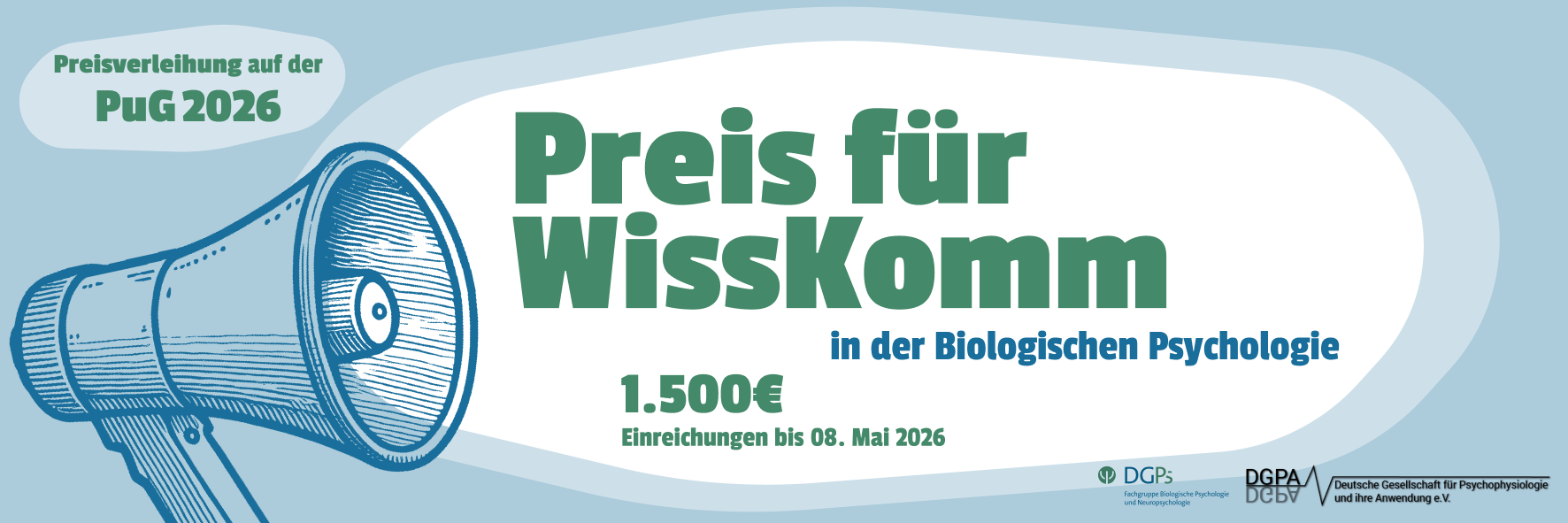
Science communication (SciComm) is when scientists themselves bring their work to life for the public, using formats like social media, blogs, radio, television, science slams, or events such as the Long Night of Science. This year, we especially want to highlight WissKomm projects in biological psychology and neuropsychology. We are awarding one prize of 1,500 € to a member of bioDGPs or DGPA. It recognizes outstanding achievements in bio- and neuropsychological SciComm and highlights work that has made a significant impact in the field.
More information (in German)
Mission WissKomm
Uns ist die Förderung guter Wissenschaftskommunikation sehr wichtig. Es stellen sich erfahrene Wissenschaftskommunikator*nnen der Fachgruppe zur Verfügung, um Tipps zu geben oder um sich zu vernetzen.
Ansprechpartnerinnen hierfür sind:
● Helena Hartmann
● Juliane Nagel
● Barbara Schmidt
● Christine Blume
● Sandra Zänkert
Der Preis wurde seit seiner erstmaligen Vergabe 2021 bis 2024 als “Förderpreis Ambassador für Wissenschaftskommunikation” verliehen. Ab 2025 sponsert ihn die Fachgruppe Biologische Psychologie und Neuropsychologie zusammen mit der Deutschen Gesellschaft für Psychophysiologie und ihre Anwendung (DGPA) unter dem Namen “Preis für Wissenschaftskommunikation in der Biologischen Psychologie”. Der Preis wird jedes Jahr auf der Tagung “Psychologie und Gehirn” verliehen.
Wir schreiben einen Förderpreis für Mitglieder der bioDGPs oder DGPA aus, der mit 1.500 € dotiert ist. Wir wollen Anreize schaffen, auch in Zukunft exzellente Wissenschaftskommunikation zu betreiben. Für diesen Zweck haben wir die Förderlinie „Konzept zur Förderung von Wissenschaftskommunikation“ für ein Jahr konzipiert.
Jury
Die/Der Gewinnerin wird von einer unabhängigen Jury, bestehend aus acht Expertinnen für Biologische Psychologie und/oder Wissenschaftskommunikation, ausgewählt:
● Steffi Peykarjou (Vertreterin der bioDGPs)
● Daniela Mier (Vertreterin der DGPA)
● Fabian Hutmacher (PsyComm IG)
● Jan Crusius (In-Mind Magazin)
● Sophie Elschner (Comiczeichnerin)
● Ulrich Grünewald (WDR Quarks)
● Agata Patyczek (Gewinnerin 2025)
● Sude Yüksel (Content Creatorin)
Bewerbung
Bewerben können sich Nachwuchswissenschaftlerinnen (Doktorandinnen und Postdoktorandinnen) als Einzelpersonen oder Teams, die ein WissKomm-Projekt mit klarem Bezug zum Fach Biologische Psychologie und Neuropsychologie, bzw. Psychophysiologie planen. Der/die Hauptbewerberin muss bioDGPs- und/oder DGPA-Mitglied sein bzw. werden. Wenn ihr mit der Bewerbung erst Mitglied werdet, legt bitte eurer Bewerbung die Kopie des Mitgliedsantrags bei.
Evaluationskriterien
Alle Beiträge, die diese Kriterien erfüllen, werden dann von der Jury bezüglich der folgenden Evaluationskriterien begutachtet:
● Wissenschaftliche Qualität (über Quantität) und Transparenz (z.B. Angabe von Quellen, Verweise auf Unsicherheiten oder Widersprüche und Genauigkeit/Differenziertheit der Aussagen)
● Anschaulichkeit und Verständlichkeit der Aufbereitung und Darstellung (z.B. inhaltliche Übersichtlichkeit, anschauliche Erklärungen, passend für die jeweilige Zielgruppe und das Medium)
● Generierung von Interesse an Wissenschaft (z.B. für die wissenschaftliche Arbeitsweise begeistern, Impulse geben, die Rezipientinnen in ihrem eigenen Denken über Wissenschaft unterstützen)
● Reichweite und Beständigkeit (regelmäßige Beiträge, die entweder eine große Zahl an Rezipientinnen erreichen oder intensiver Austausch mit wenigen Rezipient*innen)
● Nachhaltigkeit (inwiefern bleiben die Beiträge langfristig für andere verfügbar und sind auch nach Jahren noch abrufbar und informativ?)
● Durchführbarkeit des Projekts
● Motivation der bewerbenden Person/des bewerbenden Teams
● Diversität der Formate der Kommunikationsbeiträge
● Innovation und “Out of the Box” Denken
● Professionalität der Darstellung
Bewerbungsablauf und Fristen
Das ausgezeichnete Konzept wird bei der Preisverleihung auf der Tagung “Psychologie und Gehirn 2026” in Heidelberg prämiert, eine Vorstellung des Projektergebnisses erfolgt dann auf der Tagung “Psychologie und Gehirn 2027” in Oldenburg.
Die Überprüfung des Fortschritts des geförderten Projekts erfolgt anhand eines einzureichenden Berichts (ca. 1 Seite) nach sechs Monaten, der von den Organisator*innen des WissKomm-Preises geprüft wird. Sollte sich herausstellen, dass das Projekt nicht oder nur in geringem Maße vorangeschritten ist, kann einmalig eine angemessene Fristverlängerung
gewährt werden. In diesem Fall ist nach Ablauf der vereinbarten Frist ein weiterer Bericht über den Projektstand einzureichen. Ihr könnt Eure Unterlagen auf Deutsch oder auf Englisch einreichen. Bei Teams sollte klar hervorgehen, welche Aufgaben welches Teammitglied übernommen hat und übernehmen wird.
Für den Preis werden derzeit Bewerbungen bis zum 08.05.2026 entgegengenommen. Die Bewerbung umfasst einen kurzen Lebenslauf, ein geplantes Konzept zur Wissenschaftskommunikation mit Zeit- und Finanzplan und ein Motivationsschreiben. Bitte verwende für deine Bewerbung nur dieses Dokument und lade deine endgültige Bewerbung als ein PDF-Dokument (mit dem Namen „FirstName_LastName_SciCommPrize2026.pdf“) hier hoch.
Wenn ihr Fragen habt, schreibt an Alexandros Kastrinogiannis (kastrino@cbs.mpg.de) oder Maren Klingelhöfer-Jens (m.klingelhoefer-jens@uke.de).
We are offering two workshops in the run-up to the conference. We recommend early registration, as the number of participants per workshop is limited. Places will be allocated in the order of registration. Workshops will be held in English.
Workshop 1 (Using Virtual Reality (VR) – A practical Workshop on using the Open VR package EDIA) will take place on Tuesday, June 2nd, 2026 (9:00-18:00) and Wednesday, June 3rd, 2026 (9:00-13:30).
For Workshop 2 (Functional Neuroanatomy – A hands-on Workshop to interact with the Human Brain) there will be two identical options to participate: either Tuesday, June 2nd (14.30 – 18 Uhr) or Wednesday, June 3rd (9.00 – 13.30).
The functional neuroanatomy workshop is now fully booked, but you can still sign up for the waiting list.
The cost for Workshop 1 is 20 euros for members of both bioDGPs (section Biological Psychology and Neuropsychology) and DGPA members, 70 euros for members of either bioDGPS or DGPA, and 120 euros for non-members, and includes participation and coffee breaks.
The cost for Workshop 2 is 10 euros for members of both bioDGPs (section Biological Psychology and Neuropsychology) and DGPA members, 35 euros for members of either bioDGPS or DGPA, and 60 euros for non-members, and includes participation and coffee breaks.
You can also become a member during workshop registration. To register, please fill in this google form: You will be asked to indicate (a) which workshop you want to participate in, (b) your current status (PhD, PostDoc, etc.) and (c) a proof of your DGPA/bioDGPS membership status (if applicable). For questions regarding pre-conference workshops, please email pug.workshops@gmail.com.
Workshop details
Workshop 1 Using Virtual Reality (VR) – A practical Workshop on using the Open VR package EDIA
This Workshop will introduce participants to the fundamentals of developing VR experiments in Unity, a versatile and widely used real-time 3D engine, and provide an opportunity for collecting hands-on experience in building interactive experimental scenarios.
A central part of the workshop will focus on EDIA, an open-source framework designed to streamline VR development for scientific experiments. EDIA reduces implementation overhead by offering reusable architectural patterns and pre-configured components, supporting rapid iteration and scalable project structures while keeping study-specific interaction logic and Unity scene setup under the researcher’s control. EDIA further facilitates the integration of eye tracking and the synchronization with external data streams (e.g., physiological recordings) via the LabStreamingLayer (LSL) protocol.
This workshop is suitable for researchers, developers, and students interested in integrating immersive methods into behavioral and neurocognitive research. Prior Unity experience is helpful but not required.
Workshop Team: Aleksandros Kastrinogiannis, Felix Klotzsche, Jeroen de Mooij
Workshop 2 Functional Neuroanatomy – A Hands-on Workshop on the Human Brain
In this workshop, participants will be able to take a deep dive into neuroanatomy of the human brain. They will have the opportunity to examine brain plastinates and will be shown and explained anatomical specimens under the guidance of neuroanatomist Prof. Dr. Joachim Kirsch, in collaboration with Prof. Dr. Beate Ditzen. This session provides a unique opportunity to study real brain structures and relate them to the abstract representations of activation patterns and neural pathways commonly encountered in research.
Workshop Team:
Prof. Dr. Joachim Kirsch is a medical doctor and Head of the Dept. of Medical Cell Biology, Institute for Anatomy and Cell Biology at Heidelberg University. He is an expert in neuroanatomy with his work bridging neural macrostructure with cellular communication processes.
Prof. Dr. Beate Ditzen is a psychologist and Head of the Clinical Biopsychology and Psychotherapy Unit at University of Zurich. With post-graduate training in neuroscience from the ZNZ Zurich, she is an expert in the neuroendocrine mechanisms underlying social attachments.
The meeting of ECRs will start on Wednesday, June 3rd at 14:15 (Psychologisches Institut, Hauptstraße 47-51, 69117 Heidelberg). The meeting is open for master students, doctoral candidates, post-docs and junior professors. It serves to exchange ideas and network amongst all early career scientists.
First, the ECR representatives of the DGPs Biological Psychology and Neuropsychology Section (bioDGPs) and the DGPA will report on their activities in the past year and give an outlook on the activities planned for the coming year. We always highly appreciate your ideas, suggestions, and feedback!
Following the introduction, there will be two consecutive sessions. First, we are welcoming Prof. Dr. Andrea Kübler (University of Würzburg) as a guest, who will be discussing power abuse in academia. Afterwards, we will offer two round tables in an open format.
1. For newer researchers and PuG first-timers, we will host roundtables on topics such as “how to conference”, networking, and other topics that are especially relevant to ECRs.
2. For more senior ECRs, we will host a round table around “how to grant write” – sharing tips, tricks, and pitfalls.
At the end, we will all reconvene for a short wrap-up. Following the ECR Meeting, we will set off together for the conference welcome evening around 17:30. We look forward to seeing and getting to know you at the meeting!
Our Posterblitz Symposium offers a stage for early career researchers. Here, innovative research projects by you ECRs are presented to as broad a professional audience as possible. Specifically, the symposium consists of ten five-minute short presentations, each followed by three minutes of questions.
You can apply for participation in the poster flash when submitting your poster contributions. Simply check the appropriate box in the online form when submitting your abstract. So that we are not influenced by your results in our selection, we ask you to write a results-blind abstract for the poster flash.
Among the submissions, a jury consisting of ECRs of the DGPA and the DGPs Section Biological Psychology and Neuropsychology, will select the best ten abstracts in a double-blind review procedure. We will then inform you in a timely manner about the selection.
Our evaluation criteria are: clarity of presentation, study design, theoretical derivation of hypotheses, and incorporation of open and reproducible science practices. We look forward to reading your abstracts!
The Buddy Program will take place for the fifth time at the PuG and connects PuG newcomers (mentees) with experienced PuG participants (mentors) in so-called “buddy teams”. The program is designed to help mentees get their bearings at PuG, meet nice people, and expand their network. During conference registration, you have the option to sign up for the buddy program. Please ensure you register at least four weeks before the conference, as for later sign-ups we cannot guarantee a mentee or mentor pairing.
The basic idea
When attending a conference for the first time, it’s easy to feel lost. It’s not just a matter of mastering the logistics and finding the right lecture rooms at the right time. Making contact with other colleagues can also be a challenge. And then there’s the social program – what should I take part in?
In our buddy program, mentors can be a helpful support: they introduce their mentees to the PuG world, give tips, provide an overview, and give a little push when it comes to networking. Conversely, the mentors also expand their network through their mentees and possibly get to know PuG from a different perspective.
What tasks do the mentors have, and what can the mentees expect?
There are no fixed requirements for the individual buddy teams. We recommend at least one personal meeting before or at the start of the PuG, for example, during the welcome evening. Mentors can share tips and tricks about the PuG process (e.g., “How do I decide which sessions to attend?” or “How do I minimize stress during a packed PuG day?”), recommend events (e.g., the ECR meeting), or introduce their mentee to colleagues. Informal exchanges about research topics or introducing other colleagues are also ways to help mentees get off to a good start in the PuG community. Mentors can also be available to answer questions during and before the PuG. ECRs who are already receiving support through their research group can benefit from the additional perspective that “external” mentors can provide.
Please note that to become a mentor, you do not necessarily need to be a senior researcher or postdoc already. There is no formal requirement. If you have already attended the PuG a couple of times, you likely already qualify as a mentor and can share useful tips to PuG newbies.
As in previous years, we are again honoring outstanding supervisors with the Supervisor Award of the DGPA and the DGPs Division Biological Psychology and Neuropsychology. Nominations can be made by filling in an online survey, which covers questions about supervision during the PhD. The prize will be handed over during the PuG social event.
Who can nominate supervisors?
The nomination survey is open to all individuals who are currently doing their doctorate (supervision relationship of at least 6 months) or who have completed their doctorate within the last 24 months. For a valid nomination of a supervisor, at least two independent evaluations must be received.
In order to complete the survey, the nominated supervisor must verbally agree to the Privacy Policy Information. This document is linked in the survey. Please forward the document to your nominated supervisor. A signature or other written confirmation is NOT necessary; it is sufficient to show the document.
The survey is available here and will additionally be circulated via mailing lists and social media.